
🟦 Yet another battery question...
Can two Lithium batteries with different Ah capacities be installed together?


Everyone,
I’ve answered this before, but here’s an interesting question on the Airstream Addicts Forum about combining Lithium batteries with different Ah capacity.

Can two batteries with different Ah be installed together?
Thinking of adding an Epoch 300AH battery into the battery box upfront. Then, at a later date, build a much more robust system by adding larger batteries to the front storage compartment of a Globetrotter 25FB.
I have a few irons in the fire at the moment, and need to replace existing batteries without going overboard on a power build. - Cliff
Hey Cliff,
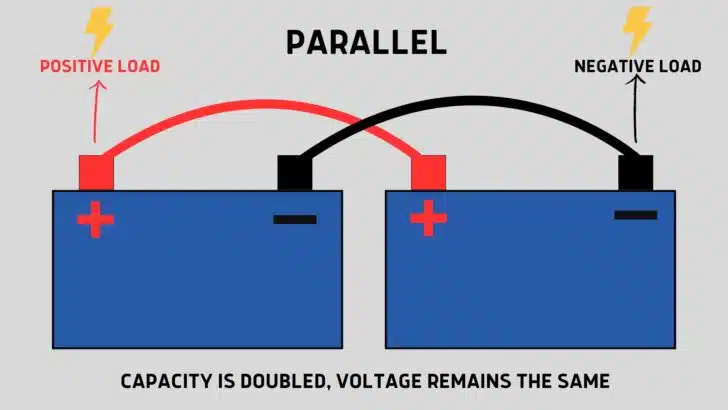
I’ve discussed this topic with engineers from several different Lithium battery manufactures, and they all say that any batteries connected together in parallel must be the same brand, model and Ah capacity for equalized SoC during charging and discharging cycles.
Also, it’s best if they have the same age. While you may be able to add a second matching battery later without problems, you should confirm this with your battery manufacturer. The bottom line is if you mix batteries of different brands or Ah capacity you’ll most likely degrade their performance and shorten their lifespan.
Read my in-depth article on mixing batteries below.

Let’s play safe out there… Mike

I too would like an explanation as well as further clarification. In real world application, such as in an RV that is not used full time and spends , say, 50% of the time on shore power, is the loss or degradation significant? For example: if the degradation is say an additional 10% for a system that is rated for 80% of capacity at 10K cycles. Is that really significant? Is it worth scrapping the 3 -12v 100 Ah of BB batteries you bough 3 years ago and cycled 100 times camping during that time period because you wanted to double your capacity at 1/5th the cost by add a Eco-worthy 12V 314Ah? I can understand engineers saying "for best results you need to replace the entire system" but is it cost effective to get maximum efficiency?
I'd be interested in a technical explanation of why different-capacity LiFePO4 batteries which each have their own built-in BMS can't be paralleled, especially if they have essentially the same voltage vs. % SOC profile (same type of internal cells). At a glance, each battery should readily deal with the bus voltage (as a single battery does), and when it reaches full charge or minimum charge, the BMS should happily disconnect it. If the wiring is good, they should even contribute their proportional share of capacity, at least near the end of discharge, where the terminal voltage will allow better current sharing. Is there a physical explanation of any performance detriment that a BMS would allow, simply due to a neighboring battery (or even two or three identical neighboring batteries, together having more capacity) being connected?