
Will plugging into a 20-amp hookup save power compared to a 50-amp hookup?
Let's take a look at how energy is measured in a campground (or your stationary house)...

Hi Mike,
I had a question about something I personally do with our RV. At night, we sometimes run on a 20-amp hookup, but during the day we switch back to 50 amps. I was wondering if there are actual advantages to doing that, like reducing electrical load, heat, pedestal strain, or power issues, or if it really doesn’t make much difference. - Tyler
Hi Tyler,
I had the same fundamental question when I was first discovering how batteries and wiring worked when I was around 6 years old. I had the misconception that somehow the electricity would get “lost” in thick wires, so I needed to use skinny wires for small amounts of electricity and thick wires for large amounts of electricity. Turns out I was wrong about needing skinny wires for small amounts of electricity.
It wasn’t until I was 10 years old (yes, I remember it) that I had my epiphany about resistance and why heavier wires with lower resistance could carry more current without overheating.
Will you use less power if you plug into a 20-amp outlet at night?
The answer is no. Energy use is determined by volts x amps x time. It doesn’t matter what kind outlet you plug into, as long as you don’t ask it to provide more amperage than it’s rated for.


What measures electrical usage?
That’s exactly how a kWh (killowatt hour) meter works. Here’s a digital kWh meter on my lab bench that measures the current and voltage, then adds up the wattage used over time to calculate how much energy you used (and how much you have to pay for it).
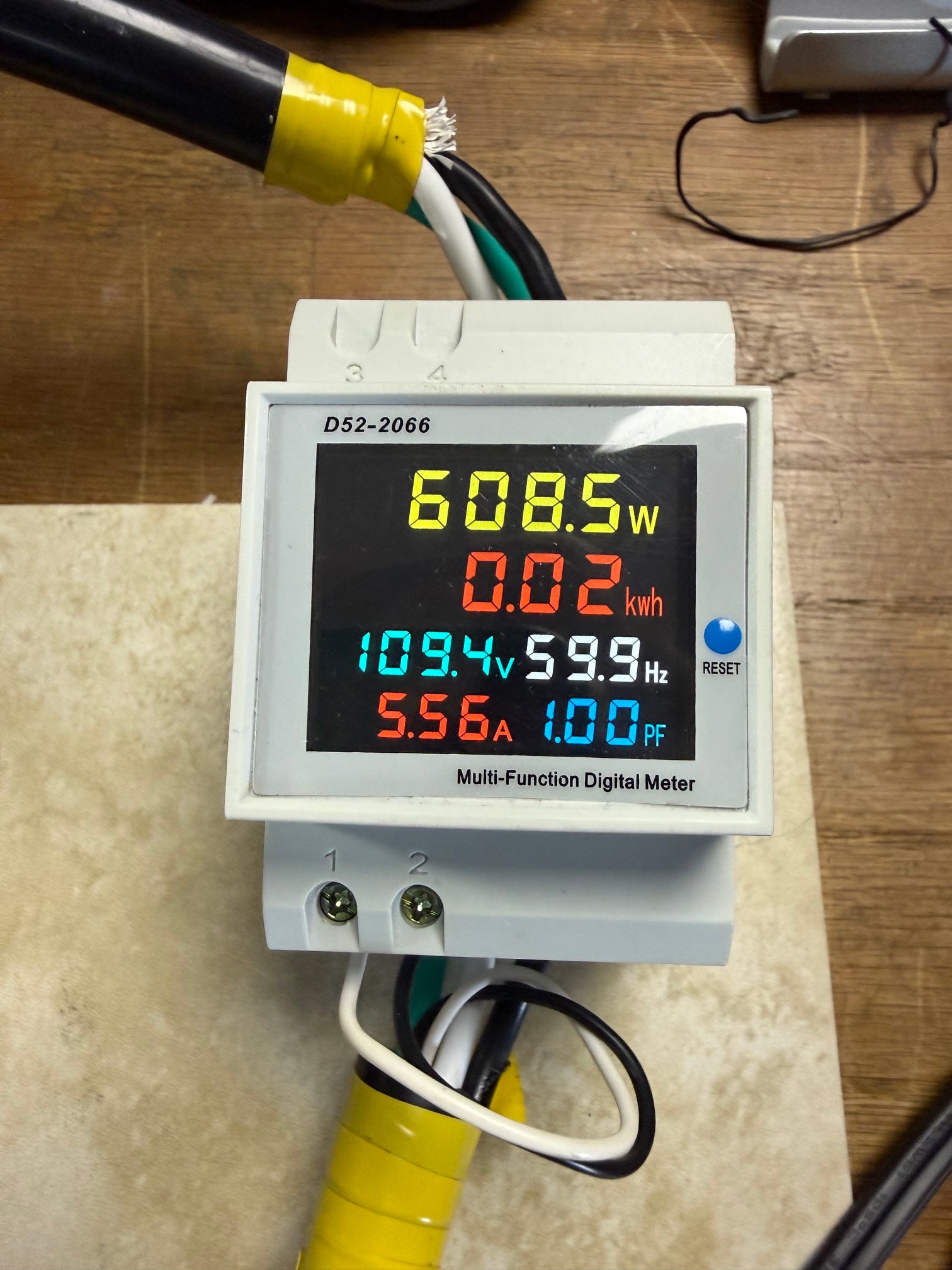
So a 10-amp load like you might have in your RV overnight will use exactly the same amount of energy (kWh) from the campground (or your house) even if it’s plugged into a 20, 30 or 50 amp outlet. There’s no advantage to plugging into a lower amperage outlet during times when you’re not using much power (like overnight).
Of course, you can’t plug a 50-amp load into a 20-amp outlet since that will quickly trip the circuit breaker.
Let’s play safe out there… Mike

Wow, at 10 years old your knowledge of power, resistance and heat were way ahead of me. It wasn't until Jr College Electronics where we learned power P is equal to Voltage times the Current and that using Algebra to change the formula when only the Current and Resistance are known, the formula can be re-written to P = I squared times R resistance (i.e, pronounced I-Squared R) based on a mis-engineered copper wire that's too small or more practically speaking economic reasons (a long, large copper conductor wire soon gets pricey).
https://en.wikipedia.org/wiki/Copper_loss#Calculations
I have a question somewhat related to this: Is there a difference if everything is plugged into one 120-volt leg? Not somewhat evenly to each 120-volt leg. Does this show higher power use if each item is plugged into one leg, not evenly if both 120-volt legs?