
🟦 Battery Testing Safety
Since I'm going into extreme testing mode, I'm adding more safety measures...


Everyone,
Read the previous article on my battery testing procedure HERE.
Update!
It does look like there’s a pair of well-used Battle Born batteries on their way to me. So in another week I can begin load testing using batteries that have had a lot of road use (and vibration). They should arrive soon.
Plus I’ve ordered my vibration table that has a road simulation mode that can randomly sweep test frequencies up to 400 Hz. That should arrive in a week or so.
Safety First
I’ve not observed anything that would indicate terminal overheating or fire danger while charging and discharging a 100 Ah Battle Born battery at 50/60 amps of charging and 70 amps of discharge current in 80 degrees ambient temperature. However, I’m planning on a few stress tests at higher ambient temperatures (up to 100 degrees F) and discharging at the limits of the BMS (around 100 amperes).
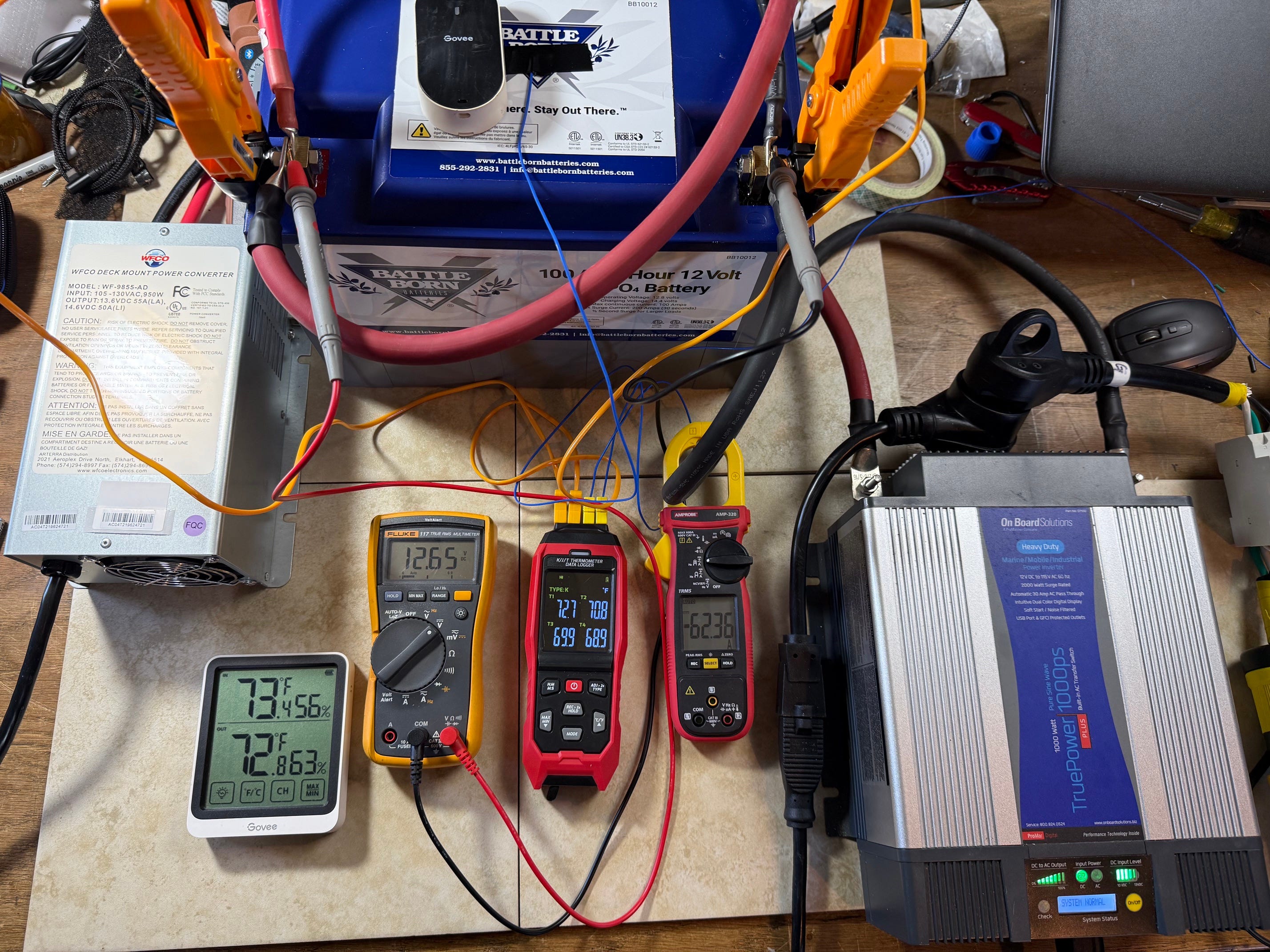
Now, be aware that any normal RV owner is not going to be stress testing their batteries like I am. That is, you won’t be fully charging a 100Ah battery at 0.5 C (50 amps) and discharging at 1.0 C (100 amps) several times a day while camping. Normally you would have 2 to 4 batteries that would divide the in/out current across all the batteries. So a 100-amp current needed by an inverter outputting around 1,100 watts would actually require 25 amps each from 4 batteries. But I’m taking it to the limit in the interest of science.
Steel Battery Box
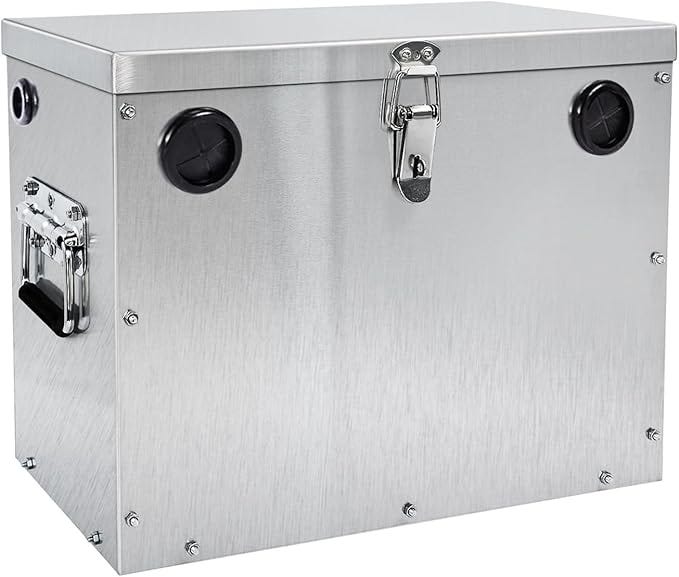
I’ve just received a stainless steel box for the test battery which has a pair of handles in case something goes wrong and I need to get it out of my FunkWorks Lab in a hurry. Plus it will be easy to get the battery temp up to whatever I like.
Quick Disconnects
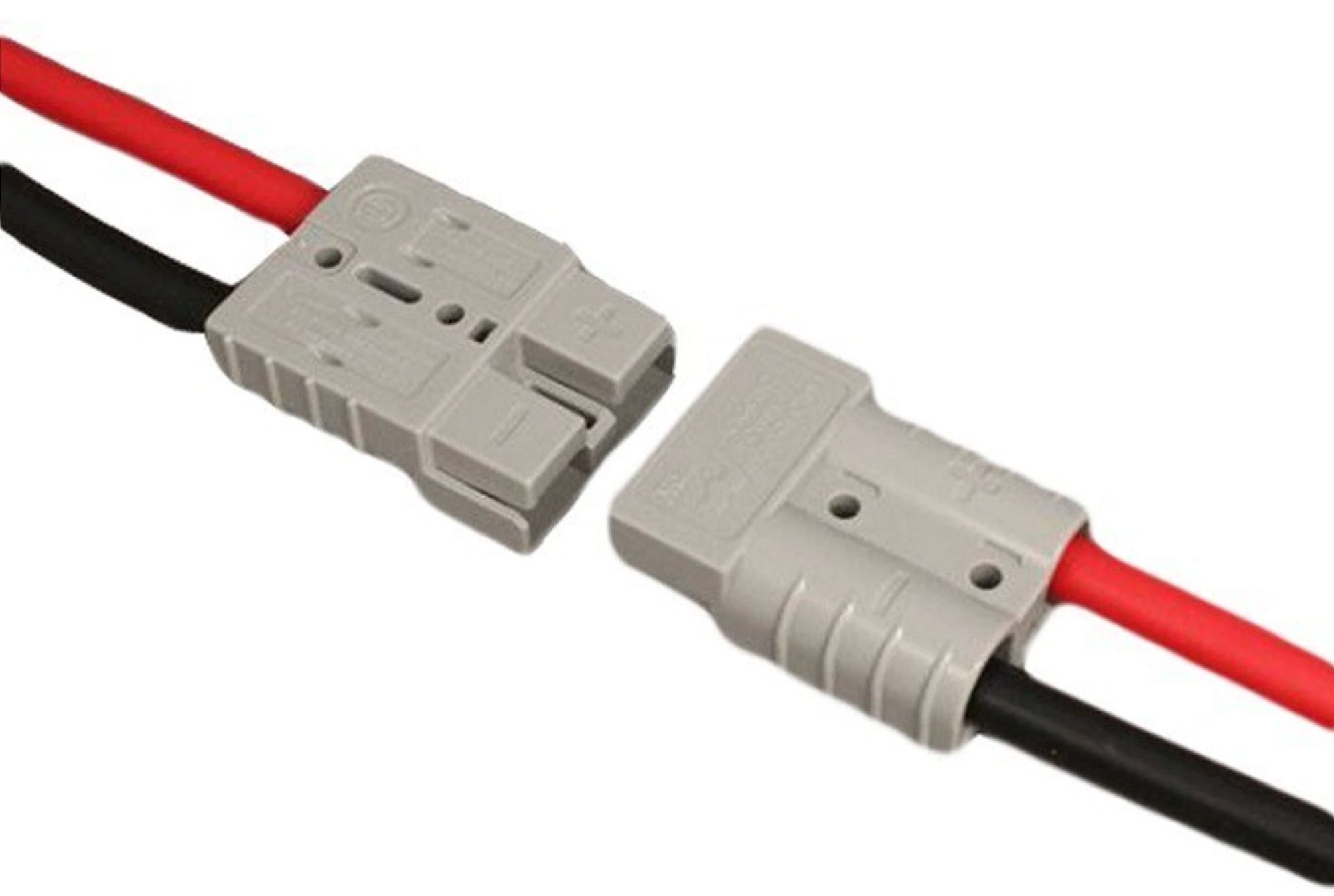
I’m also adding Anderson connectors on all three batteries so I can easily swap them in and out of the test bench or onto the vibration table. Plus if something does go wrong I can quickly unplug and carry the battery in its steel box out to my concrete deck that’s only 20 feet away.
Shake it up, baby…
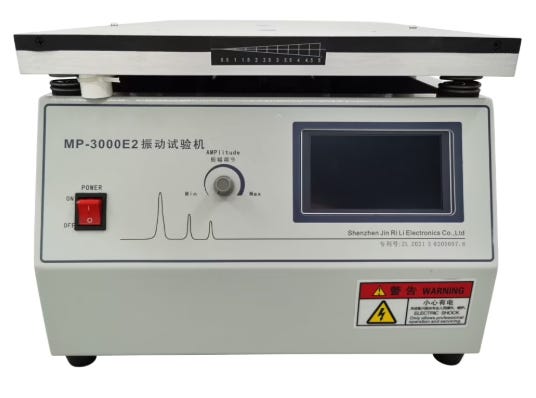
The vibration table is on its way, which I’ll keep running by swapping all three batteries on it one at a time. It has all kinds of built-in memory functions so I can keep track of which battery is getting which vibration test. Plus it has all kinds of randomized vibration test cycles.
Fuses
And yes, while the BMS should protect the 2/0 conductors in the event of a short circuit, I’m adding a 100-amp fusible link in each high-current path.
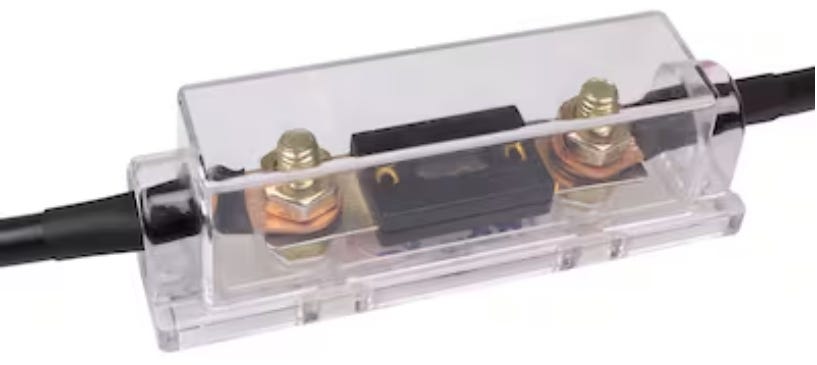
More on this later
Please stand by for more test results. As noted, I have not observed any dangerous overheating effects as of yet, but I’m watching carefully.
Let’s play (and test) safely out there… Mike

I like how thorough and methodical you're being with this. Good job, Mike!
How about how much energy is really left? There was a analysis done in 2014 on lithium batteries (lithium ion was new kid on the block back then). ltihuim batteries starts to crystalizing as soon as it is charged and continues for its life. at 2.5 to 3 years it was 50% crystalized, at 5 years it was 80% crystalized (going off old memory cells here). which is why everyone complained about their cell phones not staying charged as long as it used to. Each new chemistry was trying to slow crystallization. So it would be good to know how much energy is left after so many years (like when does it run out of "gas")?